
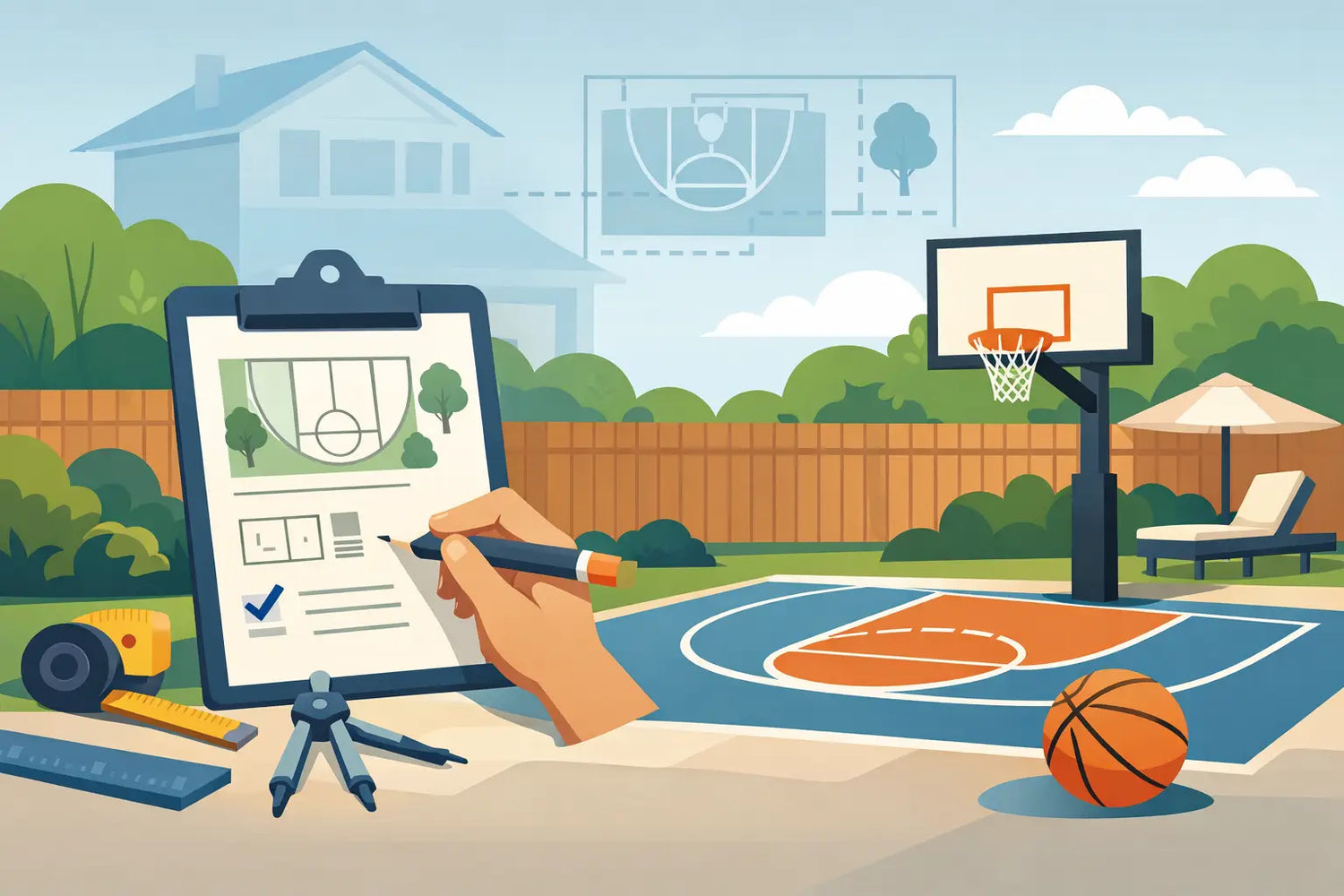
A backyard hoop looks simple until you start picturing where the ball will bounce, where players will stop, and how close that backboard sits to the driveway, patio, or fence. If you want to plan backyard basketball court space the right way, the real job is not just fitting a goal into the yard. It is creating a play area that feels safe, comfortable, and worth the investment for years.
For most families, the best court is not a full-size court. It is a well-planned court. A smaller playing area with the right clearance, surface, and goal placement will usually get more daily use than a cramped setup that technically fits but never feels quite right. That is especially true in North Carolina, where weather, drainage, and backyard layout all affect how your court performs over time.
Start with how your family will actually use it
Before you think in exact dimensions, think in real-life use. Some families want a casual space for young kids to shoot and play HORSE after school. Others want enough room for serious practice, one-on-one games, and driveway-style half-court play. Those are very different projects, and the space you need should match the way the court will be used.
A single hoop with a modest shooting area can work well in a compact backyard. If your goal is more active gameplay, you will want room for dribbling, layups, rebounds, and safe stopping distance. The mistake many homeowners make is focusing only on where the pole goes. The better approach is to plan the full movement zone around the goal.
That means accounting for the lane area, side clearance, and what happens when a player carries momentum toward the edge of the court. A basketball space that looks large enough on paper can feel tight very quickly when kids start moving at full speed.
What size do you really need to plan backyard basketball court space?
There is no single perfect backyard court size, but there are practical ranges that make sense for most homes. If you are installing one in a residential yard, a common half-court style setup often falls somewhere between 30 by 30 feet and 30 by 50 feet. A more compact recreational area may be smaller, while a more advanced practice court may need additional width or depth.
If your available space is limited, that does not mean you should abandon the idea. It means you should scale the project to fit the property instead of forcing a layout that leaves no margin for safety. Even a smaller court can be a great long-term investment when the hoop has proper overhang, the surface is level, and players have enough room to move naturally.
For younger children, a shorter playing area may be completely appropriate. For teens and adults, especially if multiple players will use the court at once, more width matters. The court should not feel like every rebound heads into landscaping, patio furniture, or the neighbor's fence.
Clearance matters more than most homeowners expect
When families measure backyard basketball court space, they often measure only the playable rectangle. That is only part of the picture. You also need buffer space around that rectangle. A few extra feet on the sides and behind the hoop can make the difference between a court that feels polished and one that feels squeezed in.
Behind the goal, extra space helps with layups, rebounds, and safety. On the sides, it keeps players from stepping directly into flower beds, retaining walls, or hardscape edges. If your yard includes slopes, tree roots, drainage swales, or raised patios, those features should be treated as part of the planning area too, even if they are outside the court lines.
Overhead clearance is worth checking as well. Low tree limbs may not seem like a problem until a high arc shot clips a branch. If the court is going near a garage, home addition, or covered patio, make sure the backboard and flight path are not competing with the structure.
Goal placement changes the entire layout
The position of the basketball goal will shape how efficient your space feels. In many cases, the best layout puts the hoop at the end of the court with enough depth in front for free throw practice, casual games, and movement. That sounds obvious, but the details matter.
Backboard overhang is one of those details. A quality in-ground basketball goal with proper overhang gives players more room under the basket, which improves safety and playability. Pole placement should support the game, not interfere with it. Premium systems are especially valuable here because they are built for stability, adjustability, and long-term outdoor use.
You should also think about sightlines from the house. Many parents prefer a court that is easy to supervise from the kitchen, family room, or patio. Convenience matters. If the court is visible and easy to access, it is more likely to become part of your family routine.
Surface, slope, and drainage are not secondary decisions
A court can have the right dimensions and still disappoint if the base is wrong. One of the biggest reasons outdoor courts age poorly is water. In North Carolina, heavy rain and seasonal moisture can expose weak drainage planning fast. Standing water shortens surface life, affects ball bounce, and creates slippery conditions.
The ideal court area should be level enough for consistent play but engineered to manage water correctly. That may mean site prep, grading, or choosing a location that naturally drains better than other parts of the yard. If your property has a noticeable slope, installation becomes even more important. A professional site review can identify whether the yard needs excavation, retaining work, or another adjustment before the goal and playing surface go in.
Surface choice also affects comfort and durability. Plain concrete may work, but not every family wants the same finish, look, or performance level. Depending on the project, added surfacing options may improve traction, reduce wear, and create a more finished recreational space. This is one of those areas where cheap decisions often become expensive later.
Think beyond the court lines
A backyard basketball area is not just a rectangle for play. It is part of your outdoor living space. That means traffic flow, seating, landscaping, and nearby play features all deserve attention.
If the court is close to a swing set, trampoline, or patio, leave enough separation so each zone feels safe and usable. You do not want basketball activity crossing directly through another play area. Families with younger children often benefit from a layout that keeps active ball play slightly offset from lower-speed backyard features.
Noise and ball travel also matter. A court placed too close to windows, vehicles, or decorative fencing may create frustration over time. If your lot is narrow, consider how rebounds and missed shots will move across the property. Sometimes rotating the court or shifting the hoop a few feet solves a problem before it starts.
Lighting can be part of the plan too. If your family plays in the evening, think about visibility early in the process. It is easier to account for lighting needs before installation than to retrofit the area later.
Budget decisions should reflect long-term use
When homeowners compare court options, size is only one cost factor. Excavation, grading, base prep, surfacing, and goal quality all affect the final investment. That is why the smartest way to budget is not to ask, "What is the cheapest way to add a hoop?" It is to ask, "What setup will still feel safe, durable, and attractive five years from now?"
For many families, a premium in-ground goal paired with professional installation is the right middle ground. It delivers a more secure playing experience than portable systems and creates a cleaner, more permanent backyard look. If you are already investing in your home and outdoor space, it makes sense to choose equipment built for repeated use and changing weather.
Financing can also make a better setup more realistic. Instead of settling for a short-term fix, many homeowners prefer to build the court they actually want and spread out the cost in a manageable way.
Why expert planning usually pays off
Backyard courts look straightforward from a distance, but the planning phase is where most expensive mistakes happen. Measuring around trees, accounting for drainage, choosing the right offset from the home, and selecting a goal that fits the users all require more than a rough sketch.
That is where expert guidance adds real value. A local team that understands backyard recreation products, site conditions, and installation can help you avoid a court that feels too tight, drains poorly, or underdelivers on performance. For North Carolina homeowners investing in a premium play space, that support matters just as much as the product itself.
Rainbow Play of NC works with families who want more than a hoop in the yard. They want a finished recreational space that fits their home, supports active play, and holds up over time.
The best backyard court is the one your family uses often and enjoys safely. If you give the space enough room to breathe, choose quality equipment, and plan around the way your household really lives, that corner of the yard can become the spot everyone heads to first after school and on the weekend.