
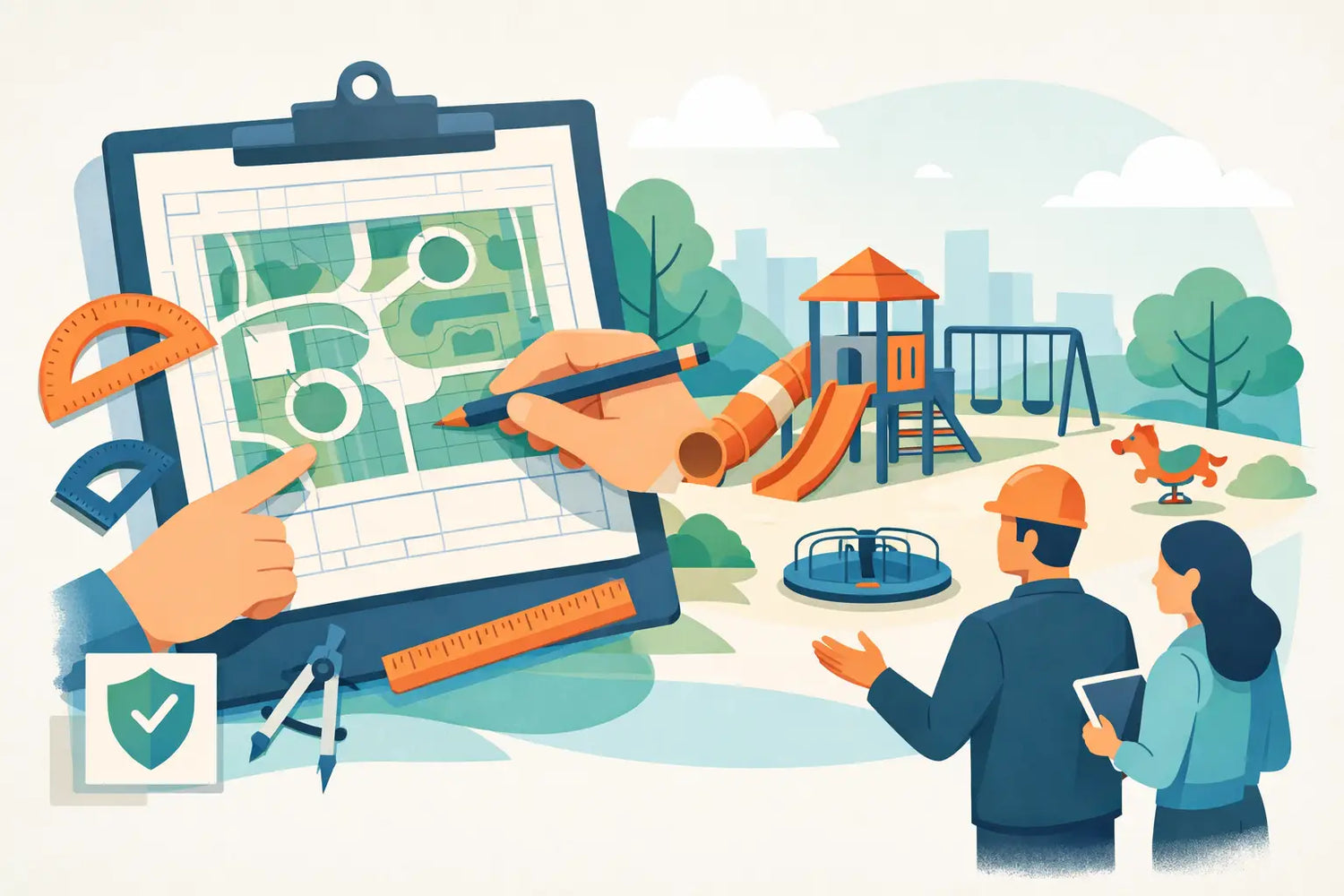
A playground can become the most active part of a school, church, childcare center, or neighborhood property - or a costly source of maintenance and safety concerns. This commercial playground planning guide helps decision-makers make the big choices in the right order, from selecting a site to choosing age-appropriate equipment, protective surfacing, and professional installation.
A successful project is not simply about fitting the largest play structure into the available space. It is about creating a place where children can move, imagine, socialize, and build confidence while the adults responsible for the property feel confident in the equipment, layout, and long-term value.
Start With the Purpose of the Playground
Before looking at colors, slides, or tower heights, define who the playground is for and how it will be used. A childcare center may need separate areas for toddlers and preschoolers. A church may need a flexible play space for weekly programs, weekday care, and family events. A school or community space may need equipment that can handle frequent, high-volume use throughout the day.
Age range affects nearly every planning decision. Equipment designed for children ages 2 to 5 has different access points, fall heights, climbing challenges, and supervision needs than equipment designed for ages 5 to 12. Mixing age groups on one structure can work in some settings, but clearly defined play zones often make supervision easier and help younger children enjoy equipment built for their abilities.
Also consider your goals beyond active play. Do you want a gathering point for families? A nature-inspired play area? Inclusive features that welcome children with varying mobility, sensory, and developmental needs? Establishing those priorities early keeps the project focused when comparing equipment options.
Assess the Site Before Selecting Equipment
The best playground design starts with the ground beneath it. A site walk should look beyond square footage to identify drainage patterns, slope, nearby traffic, utilities, mature trees, overhead lines, fencing, and sightlines from the building or seating area.
In North Carolina, drainage deserves close attention. Standing water can shorten the life of surfacing, create muddy play areas, and lead to avoidable maintenance. A slightly sloped site may be workable with proper planning, but it can affect accessibility, installation complexity, and cost. A level, well-drained area is often the simplest path to a durable result.
Leave room for more than the structure itself. Every playground needs a use zone, which is the clear area around equipment where children may fall or move during play. The required space depends on the equipment type, height, and motion. Swings, for example, need substantial clearance in front of and behind the swing bay.
A thoughtful layout also accounts for how people enter, watch, and maintain the space. Position benches and shade where caregivers can see key play areas. Plan accessible paths from parking or the building entrance. Make sure maintenance teams can reach the playground without crossing delicate landscaping or carrying supplies through a crowded facility.
Build Safety Into Every Planning Decision
Commercial playground safety is a system, not a single feature. High-quality equipment matters, but safety also depends on correct installation, suitable surfacing, proper spacing, ongoing inspections, and responsible supervision.
Look for equipment designed to meet applicable public playground safety standards, including ASTM guidelines and Consumer Product Safety Commission recommendations. Your project may also have local building, zoning, accessibility, or permitting requirements. Schools, municipalities, and larger organizations may have additional procurement or inspection procedures. Confirm those requirements before ordering equipment, not after the site has been prepared.
Guardrails, barriers, handholds, transfer points, and protective caps all contribute to safer play. Just as important, equipment should match the intended users. A tall climber may be exciting for older elementary students but inappropriate in a toddler area. Choosing the right challenge level is more effective than choosing the biggest possible structure.
Make Supervision Easier by Design
Adults cannot supervise what they cannot see. Avoid creating hidden corners behind large structures, enclosed panels, or landscaping. Place high-energy features such as swings and spinners where their movement is easy to observe and where children will not run through their paths.
Signage can support safer use, especially in shared community spaces. Age recommendations, adult supervision reminders, and basic playground rules are useful, but they do not replace a layout that naturally directs traffic and gives caregivers clear views.
Choose Commercial-Grade Equipment for Real Use
A commercial playground should be selected for the number of children who will use it, not just how it looks on opening day. Equipment for a busy childcare center, school, or church must withstand repeated climbing, swinging, weather exposure, and active play from many children each week.
Commercial-grade systems offer stronger structural components, durable finishes, and configurations designed for public use. They can also provide more flexibility than a single pre-set unit. A play village may combine climbers, slides, overhead events, sensory panels, and ground-level activities in one coordinated design. That variety helps serve different play styles while spreading children across the space.
Do not overlook standalone pieces. Swings remain one of the most popular playground activities, while freestanding climbers, balance elements, musical features, and outdoor play panels can add meaningful activity without requiring a massive footprint. For smaller properties, a carefully chosen collection of individual components may deliver better value than one oversized structure.
Durability comes with a practical trade-off: premium commercial equipment requires a larger upfront investment. However, lower-cost equipment that wears prematurely, lacks appropriate safety features, or cannot accommodate your user volume may cost more over time in repairs, replacement, and lost confidence from families.
Protective Surfacing Is Part of the Playground
Surfacing is one of the most consequential decisions in this commercial playground planning guide. It affects fall protection, accessibility, appearance, drainage, maintenance, and the overall experience for children and caregivers.
Engineered wood fiber is a familiar choice that can provide effective impact attenuation when installed and maintained at the proper depth. It has a natural appearance and may be a practical option for many sites, but it needs routine raking and replenishment. Displaced material under swings and at slide exits should be addressed promptly.
Poured-in-place rubber creates a clean, accessible surface with a polished appearance and lower day-to-day maintenance needs. It can be an excellent fit for facilities that prioritize mobility access and a finished look. Its higher initial cost should be weighed against its lifespan, maintenance profile, and the value of a consistent surface.
Rubber tiles and bonded rubber mulch are additional options, each with different installation and maintenance considerations. The right surface depends on your budget, accessibility priorities, climate, drainage, equipment fall heights, and the level of upkeep your team can reliably provide. Surfaces should be selected to match the equipment's required critical fall height performance.
Plan for Inclusive, Welcoming Play
Accessibility is more than reaching the playground gate. A welcoming space considers how children and caregivers move to, through, and around the play area. Accessible routes, firm and stable surfacing, transfer components, ground-level activities, and seating nearby all contribute to a better experience.
Inclusive design also benefits children who may not use equipment in the same way. Sensory panels, musical elements, imaginative play features, and social spaces can create meaningful opportunities beyond climbing and sliding. The goal is not for every child to use every component in the same manner. The goal is to create genuine ways for more children to participate.
When planning an ADA-conscious playground, work with qualified professionals who can help align the design with applicable requirements. Details such as route widths, surface transitions, and the number and type of accessible play components should be considered as part of the complete site plan.
Budget for the Complete Project
The equipment price is only one piece of the budget. A realistic plan accounts for site preparation, drainage work, concrete, borders or containment, surfacing, freight, installation, permits, inspections, shade, fencing, benches, and future maintenance.
It is smart to establish a target budget early, then prioritize the features that matter most. If the budget does not support every wish-list item, consider a phased design. Start with the essential play structure, surfacing, and site work, then add shade, freestanding events, seating, or expanded play zones later. The original layout should leave room for that growth.
Professional installation is not an area to treat as an afterthought. Proper assembly, anchoring, surfacing depth, and placement are central to the playground's safety and performance. For organizations across Raleigh and Eastern North Carolina, Rainbow Play of NC can help bring product selection, site guidance, delivery, and installation into one coordinated process.
Create a Maintenance Plan Before Opening Day
Every commercial playground needs regular attention. Establish who will conduct routine visual checks, who will respond to concerns, and how repairs will be documented. High-use areas should be inspected more frequently, especially after heavy rain, storms, or seasonal changes.
A practical maintenance plan should include checking fasteners and moving parts, inspecting surfacing levels and condition, removing debris, looking for damaged components, and confirming that drainage remains effective. Keep manufacturer information, warranties, installation records, and inspection notes together so they are easy to reference.
The most successful playgrounds feel effortless to the families who use them. That experience comes from careful planning behind the scenes: a site that drains well, equipment that fits the children, surfacing that protects active play, and professional support from the first sketch through installation. Start with the children who will run through the gate, then build a space worthy of their energy for years to come.