
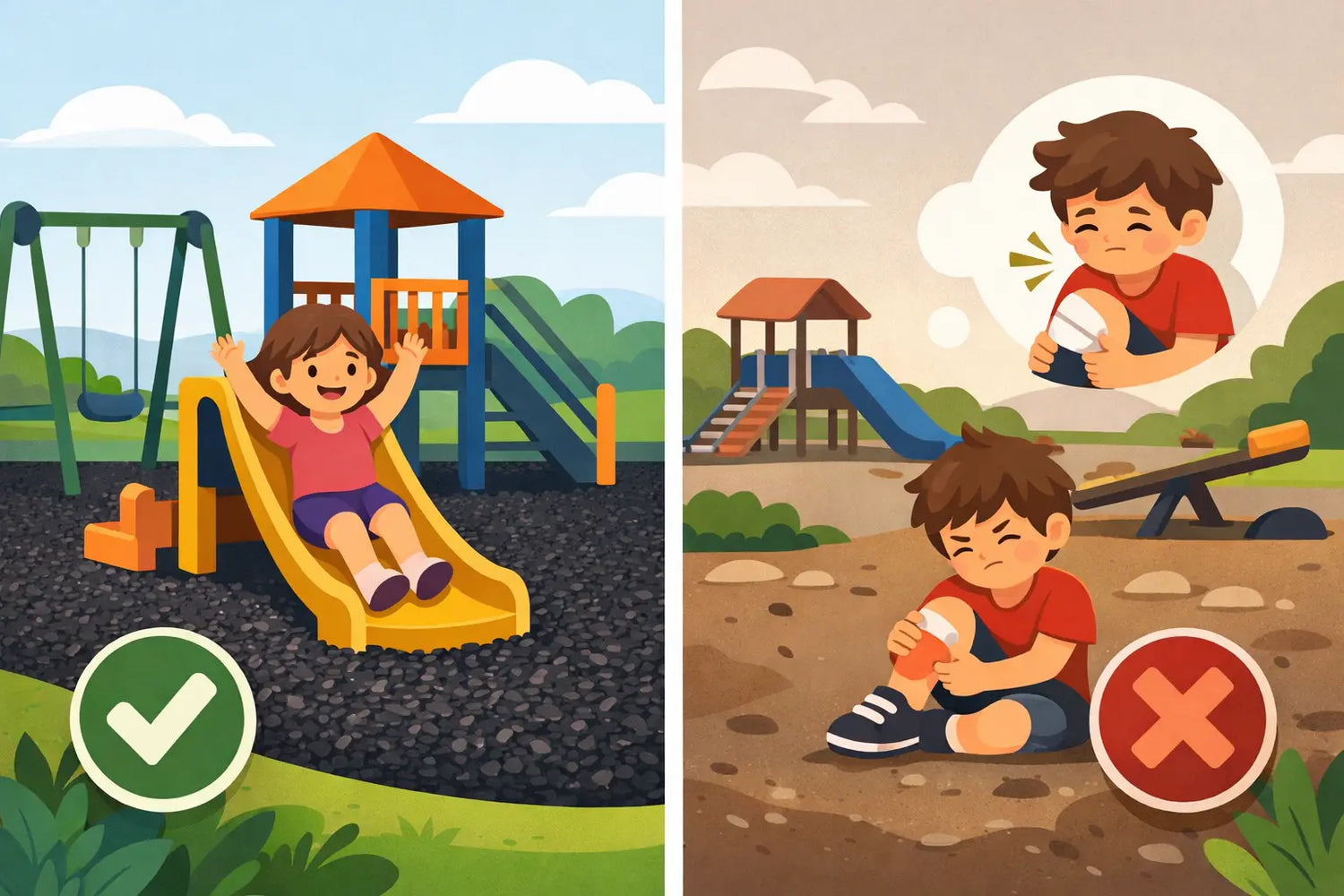
A backyard playset can look perfect on day one, but the surface underneath it is what determines how well that space holds up over time. If you're considering a rubber mulch playground, you're probably weighing more than color or curb appeal. You're trying to balance safety, maintenance, drainage, longevity, and what makes sense for your family or facility.
That is the right way to think about it. Surfacing is not an accessory. It is a core part of the play area, especially under swings, slide exits, and climbing zones where repeated impact matters most.
What a rubber mulch playground does well
Rubber mulch is made from recycled rubber that has been processed into nugget-like pieces designed for playground use. Its main appeal is impact absorption. Compared with bare ground or decorative landscape mulch, it creates a more forgiving landing zone and generally maintains better cushioning over time.
That matters for families investing in premium play equipment and for schools or churches planning a space that sees regular traffic. Children do not play lightly. They run, jump, drag toys, kick surfacing around, and wear paths into their favorite spots. A surface that keeps its depth and softness longer can reduce how often you need to top off materials and rework the area.
Rubber mulch also handles drainage well. In North Carolina, where heavy rain can quickly turn parts of a yard into a muddy mess, that can be a real advantage. Water typically moves through it instead of pooling on top, which helps keep the play area usable and cleaner after storms.
Another plus is appearance. It does not break down or fade the same way wood mulch can, and it tends to keep a more consistent look throughout the season. For homeowners who want a polished backyard and for organizations trying to maintain an inviting play environment, that visual consistency has value.
Where rubber mulch playground surfacing has tradeoffs
Rubber mulch is not the automatic best choice for every project. The first tradeoff is cost. Up front, it usually costs more than engineered wood fiber or standard mulch alternatives. For a small backyard footprint, that difference may feel manageable. For a larger commercial installation, it can be a significant line item.
The second issue is movement. Even though rubber mulch tends to last longer than wood-based loose fill, it is still loose fill. Children can kick it out of high-traffic zones, and swings will still create displacement over time. That means containment borders and occasional raking are part of the picture.
Heat is another factor. Rubber can get warmer in direct sun than some homeowners expect, especially in the peak of summer. It does not always become unusable, but it can feel noticeably hotter than shaded turf or some poured-in-place surfaces. Whether that becomes a real problem depends on your yard, your tree cover, and when children typically use the playset.
There is also a preference question. Some families simply prefer a natural-looking surface like engineered wood fiber. Others want the cleaner, more uniform look of rubber. Neither reaction is wrong. When you are building a backyard space you will see every day, that preference matters.
Is rubber mulch safer than wood mulch?
Usually, this question comes down to impact attenuation and consistency. Playground-rated rubber mulch is designed to cushion falls, and one of its strengths is that it does not decompose like wood fiber. Because it does not compact and break down in the same way, it can maintain useful shock absorption for longer when installed at the right depth.
That said, safety is never about the material alone. Depth matters. The size of the play area matters. The height of the equipment matters. Containment matters. Even the way children use the equipment matters.
A poorly installed rubber surface can underperform, just as a properly installed wood fiber surface can do a solid job. For homeowners and commercial buyers, the smarter question is not just which material is safer in theory. It is which surfacing system is the better fit for your equipment, traffic level, maintenance expectations, and site conditions.
Rubber mulch playground projects in real backyards
For many families, the decision becomes clearer when they picture daily use rather than product specs. If you have active kids, a premium wooden playset, and a backyard that gets soggy after rain, rubber mulch can solve a few headaches at once. It cushions falls, drains well, and avoids the splintered, decomposing look that makes some play areas feel tired before the equipment itself ages.
If your yard is heavily shaded, modest in size, and you do not mind occasional upkeep, other loose-fill options may also work well. The right answer depends on how much maintenance you want to manage and how long you want the area to hold a finished, well-kept appearance.
For many suburban homeowners in the Triangle and across Eastern North Carolina, convenience is part of the value equation. Saving money up front can feel less appealing if it means more frequent refills, more mess tracked into the house, or a surface that needs regular attention just to stay functional.
What commercial buyers should consider
Schools, churches, childcare centers, and community spaces tend to evaluate surfacing differently than homeowners do. Heavy use changes the calculation. So does liability, accessibility planning, and the need for a play space to stay attractive through repeated use by large groups.
Rubber mulch can be a practical option in some commercial settings, especially where drainage and long-term material life are priorities. But it is not always the final answer. Some buyers may be better served by unitary surfacing systems, depending on ADA requirements, maintenance staffing, and the type of traffic the playground receives.
This is where expert guidance matters. A surface that works beautifully under a backyard swing set may not be the best match for a church playground with daily preschool use or a large school-age play system with multiple fall zones. Commercial buyers need to think beyond price per bag and look at the full installation plan.
Installation matters more than most people expect
One reason playground surfacing disappoints is simple - the material was fine, but the installation was not. Ground prep, drainage planning, border design, geotextile use, and final depth all affect performance. Without proper containment, even high-quality rubber mulch can migrate. Without proper site prep, low spots and drainage issues can show up fast.
This is especially true when the playset itself is a premium investment. Families spending serious money on a backyard play system usually want the finished area to look intentional, not pieced together. Professional installation creates cleaner lines, more dependable coverage, and a safer final result.
That is one reason many buyers prefer to work with a company that understands both the equipment and the surfacing. It helps avoid the common problem of treating surfacing as an afterthought when it should be planned as part of the complete play area.
When rubber mulch is a strong choice
A rubber mulch playground makes the most sense when you want long-term visual appeal, better drainage, lower material breakdown, and a softer landing area that supports active use. It is often a strong fit for premium backyard playsets where families want a clean, durable look without constant top-offs.
It can also be a smart option for some commercial spaces, provided the broader site and usage demands line up with a loose-fill system. The key is knowing that rubber mulch is not simply a decorative finish. It is a safety surface, and it needs to be selected and installed that way.
For buyers who value expert support, product quality, and professional setup, working with a local team can make the decision much easier. Rainbow Play of NC helps families and organizations think through the full play environment, not just the structure sitting above it.
A great playground is not only about the tower, swings, or slide. It is also about what happens at ground level, where safety, drainage, and day-to-day durability show up every single afternoon.