
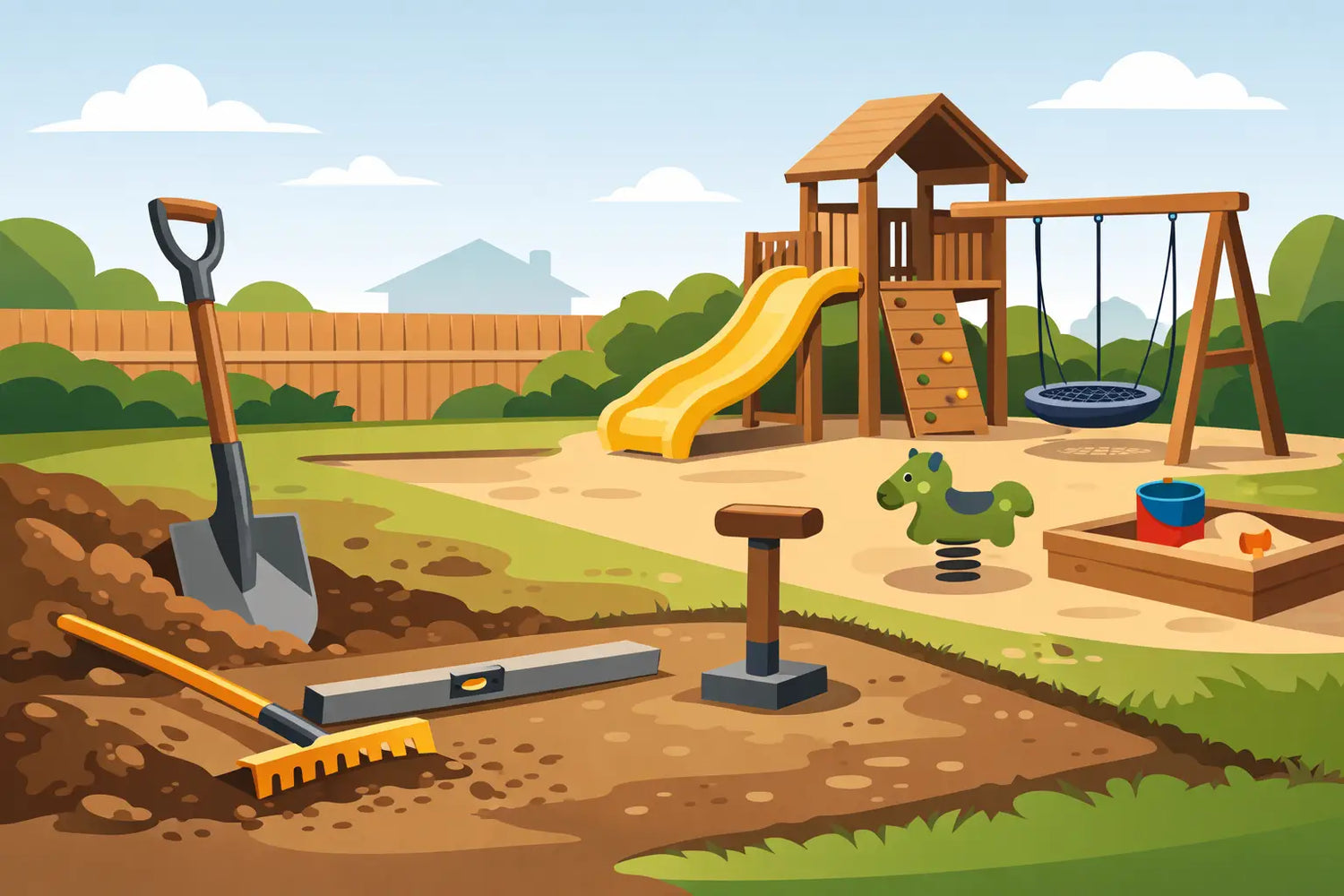
A playset can look perfect in the showroom and still fail in the backyard if the ground underneath it is off. When parents ask how to level backyard playground areas, they are usually trying to solve two problems at once - safety and long-term performance. A site that is even slightly out of level can affect stability, drainage, hardware alignment, and the way kids move through the structure.
For a premium wooden play system, the base matters just as much as the beams, slides, and swings. Good site prep helps the equipment sit correctly, keeps weight distributed the way it was designed, and reduces the chance of shifting over time. It also gives you a cleaner finished look, which matters when you are making a real investment in your backyard.
Why leveling matters before installation
Backyard play equipment is engineered to sit on a stable surface. If one side is higher than the other, the frame can twist during assembly. That may show up right away as misaligned brackets or uneven swing chains, or it may become visible later when boards settle and components start carrying load unevenly.
Level ground also supports safer play. Children climb, jump, swing, and change direction quickly. When the structure itself is not sitting evenly, the experience can feel off in ways that are hard to spot from the patio. A deck may be slightly tilted, a ladder may feel awkward, or a swing beam may not hang exactly as intended.
Drainage is the other piece homeowners often underestimate. In North Carolina, heavy rain can turn a low spot into standing water fast. If the site is not graded correctly, mulch, rubber surfacing, or borders can shift, and the ground around posts can soften. That is one reason professional installation often starts with a careful site evaluation, not just a delivery date.
How to tell if your backyard is level enough
Some yards are obviously sloped. Others look flat until you start measuring. Before you move soil or order surfacing, mark the footprint of the playset using stakes and string. Include the safety zone around it, not just the exact dimensions of the structure.
Then check elevation from one side to the other. A long straight board with a carpenter's level can work for smaller areas. For larger spaces, a string line level, transit level, or laser level gives a better picture. Measure the drop from the highest point to the lowest point across the full site.
Minor variation may be manageable depending on the equipment and the installation plan. A gentle slope can sometimes be corrected during site prep. A more significant grade usually requires excavation, retaining support, added surfacing depth, or a different location entirely. The key is being realistic early. Trying to force a large playset onto a badly sloped area almost always creates more work later.
How to level backyard playground space the right way
The right approach depends on how much slope you are dealing with, what kind of play system you are installing, and what surfacing will go underneath it. In most residential settings, leveling starts with choosing whether to cut into the high side, build up the low side, or combine both methods.
Cutting down the high side is often the cleaner solution because compacted native soil tends to perform better than loosely filled areas. If you build up the low side too much with fill alone, the ground can settle over time unless it is properly compacted in layers. That settlement can affect the structure after installation.
Start by removing grass, roots, and organic material from the site. Topsoil may look neat, but it is not the best base for heavy play equipment because it shifts more easily than compacted subsoil. Once the area is cleared, bring the site to grade gradually, checking level as you go.
If you need to add material, use a suitable fill and compact it in lifts rather than dumping it all at once. This is one of the biggest differences between a fast weekend project and a site that actually stays level. Loose fill can look fine on day one and still settle noticeably after a season of rain and use.
After grading, verify the footprint again in multiple directions. Do not assume that because the front edge is level, the whole site is ready. Check front to back, side to side, and diagonally. Large wooden playsets distribute weight across a broad base, so consistency matters.
Don’t forget drainage and surfacing
A level site does not mean a site that traps water. That is where many DIY projects go sideways. You want the playset area to support a stable installation while still allowing water to move away from the structure and the surrounding yard.
In some cases, that means subtle grading around the perimeter rather than under the playset itself. In others, it means adding edging, a drainage path, or a base preparation plan that works with the safety surfacing. Wood mulch, rubber mulch, and other loose-fill materials all behave differently after rain and foot traffic.
If you are using protective surfacing, account for depth before final installation. A site can appear level before surfacing is added and then create issues if the finished heights are not planned correctly. This matters around ladders, step entries, and slide exits, where the relationship between the equipment and the ground affects both usability and safety.
When a slope is too much for a simple DIY fix
There is a difference between minor leveling and major site correction. If your yard has a pronounced slope, visible erosion, soft ground, tree root issues, or runoff problems, this stops being a rake-and-wheelbarrow job. It becomes a sitework decision that can affect safety, warranty protection, and the life of the equipment.
The same is true for larger premium systems with multiple towers, monkey bars, or heavy swing beams. These are substantial structures, and they need a properly prepared base. A small error under a compact playset might be noticeable. A small error under a large system can multiply across the entire frame.
Institutional and church playgrounds raise the stakes even further. Higher use, broader age ranges, and commercial surfacing requirements make precision more important, not less. In those settings, leveling should be handled as part of a professional installation plan.
Common mistakes homeowners make
The most common mistake is eyeballing the yard and assuming it is close enough. The second is leveling only the visible center area while ignoring the complete footprint and use zone. That can create edge problems later when borders, mulch depth, or anchoring come into play.
Another issue is relying on loose fill without proper compaction. It saves time up front, but the ground may settle under the heaviest points of the structure. Homeowners also sometimes forget that tree roots, buried irrigation lines, and drainage paths can interfere with grading and installation.
There is also the question of time. Families often want the playground assembled quickly, especially when children are already excited about it. But rushing site prep is one of the few shortcuts that can undermine an otherwise excellent purchase. Premium equipment deserves a premium foundation.
Why professional installation often pays off
For many families, the smartest answer to how to level backyard playground areas is to have the site evaluated and installed by experts who do this every day. Professional crews know how to measure grade, prepare a stable base, account for surfacing, and assemble the equipment so it performs the way it should.
That matters for convenience, but it also matters for confidence. A well-installed playset should feel solid from the first climb and stay that way through years of active use. When installation is handled correctly, parents spend less time second-guessing the ground underneath and more time enjoying the backyard they invested in.
For homeowners across Raleigh, Cary, Apex, Durham, Chapel Hill, Wake Forest, and surrounding areas, that local support can be a real advantage. Teams familiar with regional soil conditions, rainfall patterns, and common backyard layouts can spot issues early and recommend the right solution before equipment is ever set in place.
What to do before you buy the playset
If you are still shopping, measure your intended area before choosing the system. Take note of slope, drainage, overhead clearance, fence access, and how close the site is to trees or patios. A quick site review now can prevent expensive repositioning later.
It also helps to buy from a company that understands more than product specs. The best experience comes from pairing premium equipment with delivery, site guidance, and installation support. That is especially true when your backyard is not perfectly flat or when you want a cleaner, more polished final result.
At Rainbow Play of NC, that is exactly where expert guidance makes the difference. The right playset should fit your family, your yard, and your long-term expectations for safety and durability.
A great backyard playground starts before the first beam goes up. When the ground is level, stable, and ready for real play, everything that follows works better.