
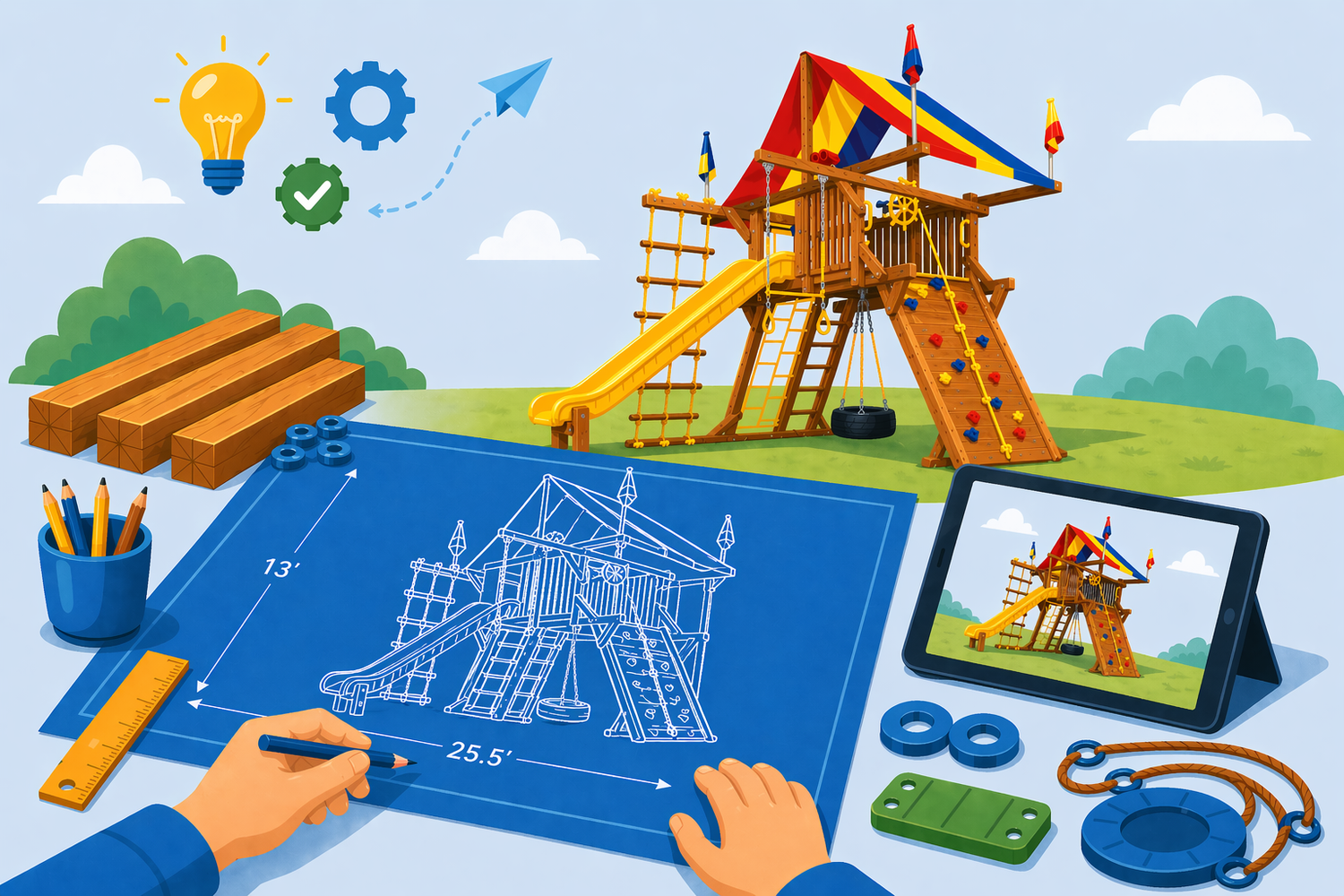
One family wants monkey bars, another needs a toddler swing, and someone always asks for a slide that feels "fast." When you design your own swing set, that mix of fun and practical decisions is exactly the point. A custom setup gives you the freedom to build around your children’s ages, your backyard layout, and how you want the space to work for years - not just for one summer.
A premium swing set is not a small purchase, and most parents know that going bigger or adding more features is not always the smartest move. The best design is the one that fits your yard, matches your children’s stage of play, and holds up through North Carolina weather, active weekends, and changing routines.
Why design your own swing set instead of buying off the shelf?
The biggest advantage is fit. A preconfigured playset can look great online and still be wrong for your yard once you factor in slope, usable play space, fencing, trees, or patio placement. Customizing lets you prioritize the features your family will actually use instead of paying for pieces that sound nice but rarely get touched.
It also helps you plan for longevity. If you have a preschooler and an older elementary-age child, your swing set needs to serve both now. That may mean combining a lower-deck play area with more active elements like climbing walls, monkey bars, or taller slides. A thoughtful design stretches the value of the investment because it stays relevant longer.
For schools, churches, and childcare spaces, customization matters even more. Age range, supervision lines, accessibility needs, and traffic flow all shape what belongs in the final layout. In those settings, a one-size-fits-all system usually creates compromises you do not need to make.
Start with the space, not the accessories
The most successful backyard designs begin with measurement. Before you choose a clubhouse roof, gang plank, tire swing, or slide style, you need to know how much clear space is available around the structure. Safe use requires room for swing movement, slide exits, and active play around the perimeter.
Flat ground is ideal, but many yards are not perfectly level. That does not automatically rule out a larger set. It just means site conditions should be part of the planning early, especially if you want professional installation and a polished final result.
Think about how the playset will sit within the rest of your backyard, too. Parents often focus on maximizing equipment size, but real family use depends on balance. You may still want room for a trampoline, a patio seating area, open lawn, or a basketball goal. A swing set should enhance the backyard, not overwhelm it.
Backyard layout questions worth asking
How close is the nearest fence line? Will the set block sight lines from the kitchen or patio? Does the space stay soggy after heavy rain? Is there enough shade, or will surfaces get too hot in full afternoon sun? These details affect daily satisfaction more than many families expect.
Choose features based on how your kids actually play
This is where custom design gets fun, but it should still be practical. Some children are climbers. Some love imaginative play in a clubhouse. Some head straight for swings every time. A good layout reflects those habits instead of trying to include every possible accessory.
Slides are usually a must-have, but the right one depends on age and confidence level. Younger kids often do better with a more approachable entry, while older kids may want something taller and more exciting. Swings are similar. A belt swing works for many children, but younger users may need a bucket seat, and some families like to mix in a glider or trapeze bar for variety.
Climbing features can dramatically extend the life of a set. Rock walls, ladders, and monkey bars tend to stay interesting longer than simpler components. Clubhouses, steering wheels, telescopes, and picnic areas add another dimension, especially for kids who like pretend play as much as motion.
That said, more is not always better. Too many attachments can crowd the layout and reduce open movement. A cleaner design with the right features usually performs better than a packed design that tries to do everything.
Design your own swing set with safety in mind
Safety should guide every major decision, from footprint to material quality to installation. Parents shopping premium play equipment are not just paying for appearance. They are paying for stronger construction, better hardware, more durable materials, and smarter engineering.
Wood quality matters. So does the way the beams are sized, braced, and assembled. Hardware should feel substantial, not flimsy. Deck heights, railings, swing spacing, and entry points all need to support confident use as children grow.
Surfacing is another part of the conversation that should not be treated as an afterthought. Grass alone may not provide the level of impact protection many families or institutions want, especially in high-use zones beneath swings and slide exits. Depending on the setting, adding proper safety surfacing can improve both protection and long-term maintenance.
Professional installation also makes a real difference. Even a high-quality playset can underperform if it is assembled incorrectly, placed on an uneven base, or installed without attention to clearances. For many homeowners, expert setup is less about convenience alone and more about getting the full value and safety of the product.
Think beyond today’s age range
A common mistake is designing only for the youngest child in the family. That makes sense in the short term, but children outgrow basic play features quickly. If your goal is a backyard investment that lasts, the design should include enough challenge to stay engaging for years.
That does not mean every set needs the tallest deck or the most advanced features. It means choosing a structure with room to grow. Modular systems are especially valuable here because they allow families to start with a strong core and expand later with additional accessories or activity sections.
This approach can also make budgeting easier. Instead of overbuilding on day one, you can invest in a premium foundation and add features as your needs change. For many families, that is a smarter path than replacing a lower-end set after just a few seasons.
Budgeting for value, not just price
There is a difference between cost and long-term value. A bargain set may look attractive upfront, but if it needs frequent repairs, feels undersized in two years, or weathers poorly, the lower price stops looking like a win. Premium play systems cost more because they are built for heavier use, longer life, and a better ownership experience.
Financing can also make a high-quality setup more realistic for families who want the right solution without compromising on safety or durability. That matters when the goal is not just to buy play equipment, but to create a backyard destination your children will use often.
What to expect from the design process
Most families benefit from seeing options in person before making final decisions. Photos can help, but they do not always show scale, build quality, or how different accessories affect the layout. Walking through designs in a showroom setting often clarifies what feels right very quickly.
A strong design process usually starts with your space, your children’s ages, and your must-have features. From there, it becomes a matter of matching those needs with the right base system, add-ons, and installation plan. If your property has challenges like slope, drainage concerns, or limited access, those should be addressed upfront instead of late in the process.
For buyers in North Carolina, local expertise matters. Weather exposure, regional installation conditions, and service support after the sale all shape the overall experience. That is part of why many families prefer working with a specialty retailer such as Rainbow Play of NC rather than treating a swing set like a generic online purchase.
When custom is worth it
If your yard is straightforward and your needs are simple, a standard configuration may be enough. But if you want the playset to complement your home, fit a specific footprint, support multiple ages, or deliver a more polished long-term result, customization is usually worth it.
The same goes for schools, churches, and community spaces. Designing around user needs, supervision, durability, and safety standards leads to better outcomes than forcing a standard unit into a demanding environment.
A swing set should feel like it belongs in your space and in your family’s routine. When the design is right, the result is not just a place for kids to burn energy. It becomes the part of the backyard where they invite friends, test new skills, and make the kind of everyday memories parents never really forget.
The best place to start is simple: measure your space, think honestly about how your kids play, and choose a design that will still make sense a few years from now.